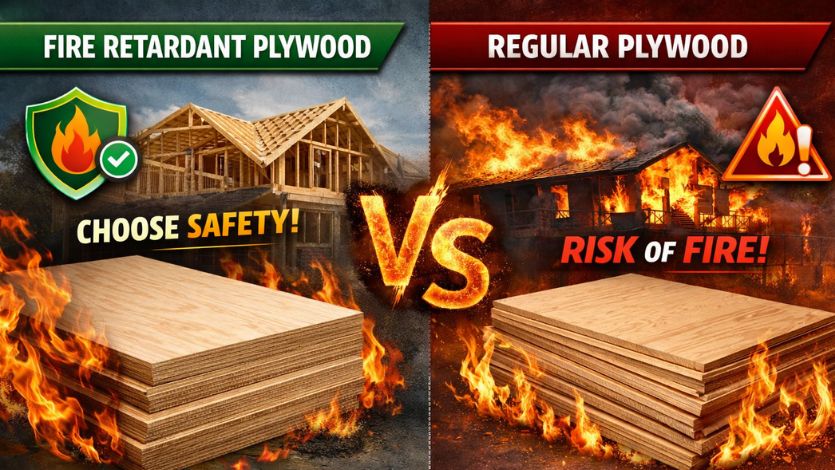
Choose Fire Retardant Plywood over Regular Plywood for better safety

What is Plywood?
Plywood is one of the most engineered wood materials that have been used as interior design and building materials. It is made through the fusion of plank veneers which lie at a right angle to each other. It is due to this cross-grain structure that plywood has been able to offer strength, longevity, and resistance to warping or breaking. Plywood is vital in offering functions and beauty, be it building furniture, designing the interior, or structural constructions.
Why Choosing the Right Plywood Is Important
Choosing the wrong type of plywood is like wearing the wrong gear to an important mission at least it might work in the meantime, but it will never protect you when you need it the most. The decision of the right plywood could play a great role in the modern world, where the durability and safety are the major concerns. Fire Retardant Plywood will also add an extra cover especially in the metropolitan where fire risk is a major concern. Now think of this: do you want one which will passively retard the propagation of fire, or one which will burn like any other wood? The solution can easily be understood but more often than not, decisions are influenced by cost, awareness and application. In order to understand both types of them better, we are going to dissect them.
Understanding Fire Retardant Plywood
What is Fire Retardant Plywood?
Fire-retardant plywood is plywood that has been treated in a very special way that causes the plywood not to burn down. Unlike the normal plywood which can be easily caught by fire, this type is chemically processed to enhance its resistance to fire. It is less hazardous in terms of interiors and construction since it produces less smoke, and it is not easily combustible. This does not mean that it is completely resistant to fire. Instead, it reduces harm and provides residents with more time to evacuate by slowing ignition and slowing down the spread of flames. This is an additional time that modern constructions are using because this additional time can literally save lives.
The Production Process of Fire-Retardant Plywood
During manufacturing of fire-retardant plywood, fire-retardant chemicals are pressure-treated. These substances are used to provide protection that is long lasting because they penetrate the wood fibers in depth. The plywood is then dried in the kiln to make it stable and maintain its structural integrity. This process will ensure that the fire-retardant qualities of the material are not added to the surface, but rather embedded in the whole material. This means that the surface can be scratched or damaged but it does not affect the fire resistance. This is one of the primary advantages in comparison to surface-coated substitutes.
Important Characteristics of Fire Retardant Plywood
By selecting Fire Retardant Plywood, you are choosing a substance that provides:
- Decreased spread of flames
- Reduced emissions of smoke
- Self-extinguishing characteristics
- Increased internal safety
- Adherence to fire safety regulations
These features make it a preferred choice for spaces where safety is non-negotiable, such as commercial buildings, hospitals, and schools.
Comprehending regular Plywood
What is Regular Plywood?
The common type of plywood is known as regular which is applied in most construction and furniture purposes. It is produced in the same layering method although no special fire resistant treatment is applied. Although it is robust, all round and economical, it does not have the safety features that Fire Retardant Plywood has. Normal plywood is also easy to set ablaze when in the presence of fire and it can lead to easy propagation of fire. This is why it is not as applicable in places where fire security is paramount of interest.
Common Uses of Regular Plywood
Despite its limitations, regular plywood is widely used due to its affordability and versatility. You’ll commonly find it in:
- Furniture manufacturing
- Wall paneling
- Cabinets and wardrobes
- Temporary structures
- Packaging materials
It’s a reliable material for general purposes, especially when fire risk is minimal or additional fire protection measures are in place.
Key Distinctions Between Fire Retardant and Regular Plywood
Capability to Resist Fire
Fire resistance is the most noticeable distinction. While ordinary plywood burns quickly, fire retardant plywood is made to slow the spread of fire. In an emergency, where every second matters, this distinction may be crucial.
Safety Requirements
Strict safety regulations and building norms are frequently met by fire-retardant plywood. Conversely, unless extra treatments are applied, regular plywood does not meet these requirements.
Sturdiness and Power
Both varieties have good structural strength, but Fire-Retardant Plywood has the extra benefit of being able to withstand high temperatures for a longer period of time. In crucial applications, this increases its dependability.
Fire-resistant plywood's advantages
Increased Security
The main benefit of fire-retardant plywood is safety. By acting as a barrier of defense, it slows down fire and gives individuals more time to respond. This can be crucial in high-risk situations.
Perfect for Business Environments
Commercial buildings, offices, and public spaces require materials that meet safety regulations. Fire Retardant Plywood is often the go-to choice in such cases, ensuring compliance and peace of mind.
Which One Is Best for You?
Your priorities will determine whether you choose normal plywood or fire-retardant plywood. Purchasing fire-retardant plywood is a wise choice if long-term protection, safety, and compliance are crucial. However, ordinary plywood can do the job well if you're working on a straightforward project with little chance of a fire.
It's similar to insurance in that you might not always need it, but when you do, it becomes priceless. This also holds true for fire safety supplies.
In conclusion
The difference between Fire Retardant Plywood and Regular Plywood is clear: the former is more focused on safety, whereas the latter is more focused on cost-effectiveness and flexibility. Safety material requirements are growing rapidly as the modern construction evolves. The choice of plywood may be long-term when designing a house, office, or business. An excellent choice of plywood products can be offered by GMG Plywood in case you are in search of high-quality, reliable, and safety-oriented plywood products. Do not put it off and establish the spaces that are beautiful and safe.
FAQs
1. Is Fire Retardant Plywood completely fireproof?
No, it is not fireproof but significantly slows down fire spread and reduces smoke.
2. Where should I use Fire Retardant Plywood?
It is best used in commercial spaces, kitchens, and high-risk areas.
3. Is Fire Retardant Plywood worth the cost?
Yes, especially in areas where safety is a priority.
4. Can regular plywood be made fire-resistant?
It can be treated, but it won’t be as effective as factory-made fire-retardant plywood.
5. Which plywood is better for home interiors?
A combination works best—use Fire Retardant Plywood in critical areas and regular plywood elsewhere.