Why Are Fire-Retardant Doors Critical to Modern Building Safety?

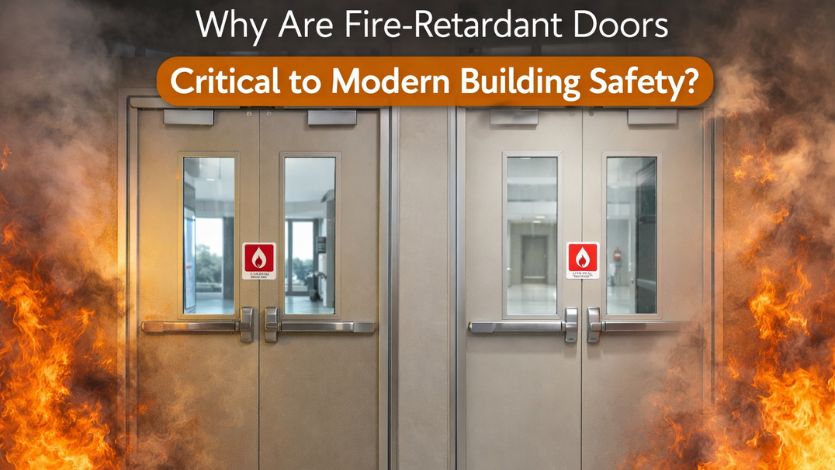
There has been an increase in the utility and aesthetic appeal of modern buildings in the fast-changing urban world. However, with the development of architecture, one cannot avoid the responsibility that is impossible to disregard: fire safety. All buildings, industrial complexes, hospitals, business offices, or residential apartments must be prepared in case of any crisis, where seconds can be the difference between the disaster and safety. This situation needs fire-retardant doors.
Fire-resistant doors do not only constitute a part of the building, but they are one of the necessary investments in building protection, human-safety, and compliance in the long-run.
Modern Construction's Rising Need for Fire Safety
Modern structures that are taller, busier, and more complicated are much more likely to experience fire incidents. Fire prevention design is an essential component of construction since high-rise residences, hospitals, hotels, offices, and industrial areas frequently have high electrical loads, flammable interiors, and high human occupancy. In these kinds of settings, fire safety is more than just using extinguishers and sirens
Fire-Retardant Doors: What Are They?
Fire retardant doors are those doors that have been designed to resist fire over a fixed time. These are the doors that help to prevent the high rate of fire propagation within the rooms, corridors, staircase, and exits. Their main aim is to provide time to the people to evacuate safely and ensure a response by emergency services. These doors are tested based on the duration of fire resistance after being subjected to controlled tests.
The Purposes of Fire-Retardant Doors: What Are They?
Fire-retardant doors are specifically made to withstand smoke and fire for a predetermined amount of time, usually 30, 60, or 90 minutes. Their job is to slow the fire, not put it out completely.
It's a crucial delay.
In the event of a fire, these doors serve as a barrier that
- prevents flames from spreading between rooms and hallways.
- decreases the flow of harmful smoke
- preserves structural integrity in the face of intense heat
Fire-retardant doors are evaluated under controlled fire circumstances, in contrast to ordinary doors. To make sure they can maintain their shape and function long enough to enable safe escape and emergency response, they are subjected to extreme heat and pressure.
How to Calculate Fire-Retardant Plywood for Doors
Plywood estimates for fire-resistant doors differ from those for regular doors or furniture. Increased thickness, increased density, and uniform internal layers are required for fire safety.
The computation is determined by:
- The width and height of doors
- Mandatory fire rating
- Thickness and core density of plywood
For instance, to satisfy its fire rating, a standard fire-retardant door needs a denser core and thicker plywood sheets. The door's resistance to smoke and fire may be diminished by any compromise in material quality or thickness.
Because of this, typical plywood calculators might not provide precise figures for applications that are fire-rated. Precise material planning is necessary for fire-retardant doors in order to guarantee performance, safety, and compliance.
Mandatory Zones for Fire-Retardant Doors in Modern Buildings
Not all places have fire-retardant doors fitted by default. They are positioned where preventing the spread of fire is essential for both safety and escape.
Typical uses consist of:
- Emergency exits and stairwells
- Lift lobbies and corridors
- Hotels, hospitals, and business structures
- Electrical rooms and industrial units
- Inspect seals for deterioration and wear.
- Make that door closers are operating correctly.
- Verify that the door closes completely and without any cracks.
- Check the stability of the locks and hinges.
- Perform recurring audits of fire safety
Fire-retardant doors in these zones aid in separating fire-prone areas and providing safe escape pathways. They lessen panic and improve the efficiency of emergency systems by slowing down smoke and flames.
Knowing where these doors are needed guarantees adherence to building safety regulations and aids in the construction of improved fire safety layouts.
Investing in fire-resistant doors is a long-term safety measure
Fire-retardant doors are required by law not only. They play a very important role in the structure of a building, and it offers long term safety. When properly planned and selected, they reduce the movement of smoke, slow down the formation of fire, and protect evacuation paths in the case of an emergency. Their value is based on how they perform at very critical moments and not on their appearance.
The addition of reliable fire-resistant doors is essential in the safety planning and adherence to the regulations when buildings become more complex and populated. It is better to invest in fire-rated systems and the right materials now, in order to prevent irreversible damage in the future.
Fire safety is not an enhancement. It is accountable.
Tips for Maintaining Fire-Retardant Doors
Regular inspections of fire-retardant doors are necessary to guarantee their long-term functionality. Important maintenance advice consists of:
Maintaining your fire safety system on a regular basis guarantees its dependability.
GMG Fire Retardant Doors: Why Choose Them?
At GMG Plywood, we recognize the value of high-quality construction and fire safety. Our fire-resistant doors are constructed with high-quality materials and they are designed to comply with the modern building safety standards. GMG has dependable solutions that have strong finishing, life span and long-term performance, be it commercial buildings, residential flats or commercial industries.
FAQs
1. What is a door that is resistant to fire?
A carefully made door that delays the spread of smoke and fire for a certain amount of time is called a fire-retardant door.
2. Do buildings have to have fire-resistant doors?
According to fire safety regulations, fire-rated doors are required in many commercial buildings, hospitals, and high-rise projects.
3. What is the typical door fire rating?
Depending on the needs of the building, common fire ratings are 30, 60, 90, and 120 minutes.
4. Can homes employ fire-retardant doors?
Indeed, for increased protection, fire retardant doors are frequently utilized in kitchens, stairwells, and apartments.